
Mille Lacs County Court Records After Jail Arrest
The local path is arrest, booking, first appearance, prosecutor review, and then a court case in Mille Lacs County District Court when charges are filed. The county jail information page says first appearance is held at 11 a.m. Monday through Friday, except county-recognized holidays, and bail is set at that hearing. Weekend and holiday arrests can therefore wait for the next regular court day. Once the case begins, the court record belongs to the Seventh Judicial District court system rather than the jail roster.
For the custody side, the roster and booking fields belong on Mille Lacs County jail inmate records. For booking photos, the roster image rules belong on Mille Lacs County jail mugshots. Court records after a jail arrest are different. They show the criminal case, the charging document, charge status, bond orders, warrant activity, hearing calendar information, and final disposition when the case reaches one.
The Mille Lacs County Attorney's Office is the local prosecutor for felony crimes in Mille Lacs County and for gross misdemeanor and misdemeanor crimes that occur outside city limits. County Attorney Corey Haller's office reviews law enforcement investigations, files criminal complaints, appears for the State in hearings and trials, and makes sentencing recommendations.
Find Mille Lacs County Court Records
Minnesota Court Records Online, or MCRO, is the public case-search portal for many Minnesota court records. A search for Mille Lacs County court records after arrest should use the county filter when possible, because common names can return cases from other Minnesota counties. MCRO is useful for locating a case number, charge list, hearing events, and case status, but it is not a certified record source. Certified copies must come from court administration.
The Mille Lacs County District Court is at 225 6th Avenue SE, Milaca, MN 56353. The court phone is 320-362-3200. Court Administrator Sara Grife is listed by Minnesota Judicial Branch, and public office hours are Monday through Friday, 8 a.m. to 4:30 p.m. The court page also warns that online calendars do not show every matter. Confidential cases and cases not remotely accessible under court rules may not appear.
The Mille Lacs County District Court page shows the local court contact point for criminal case questions.
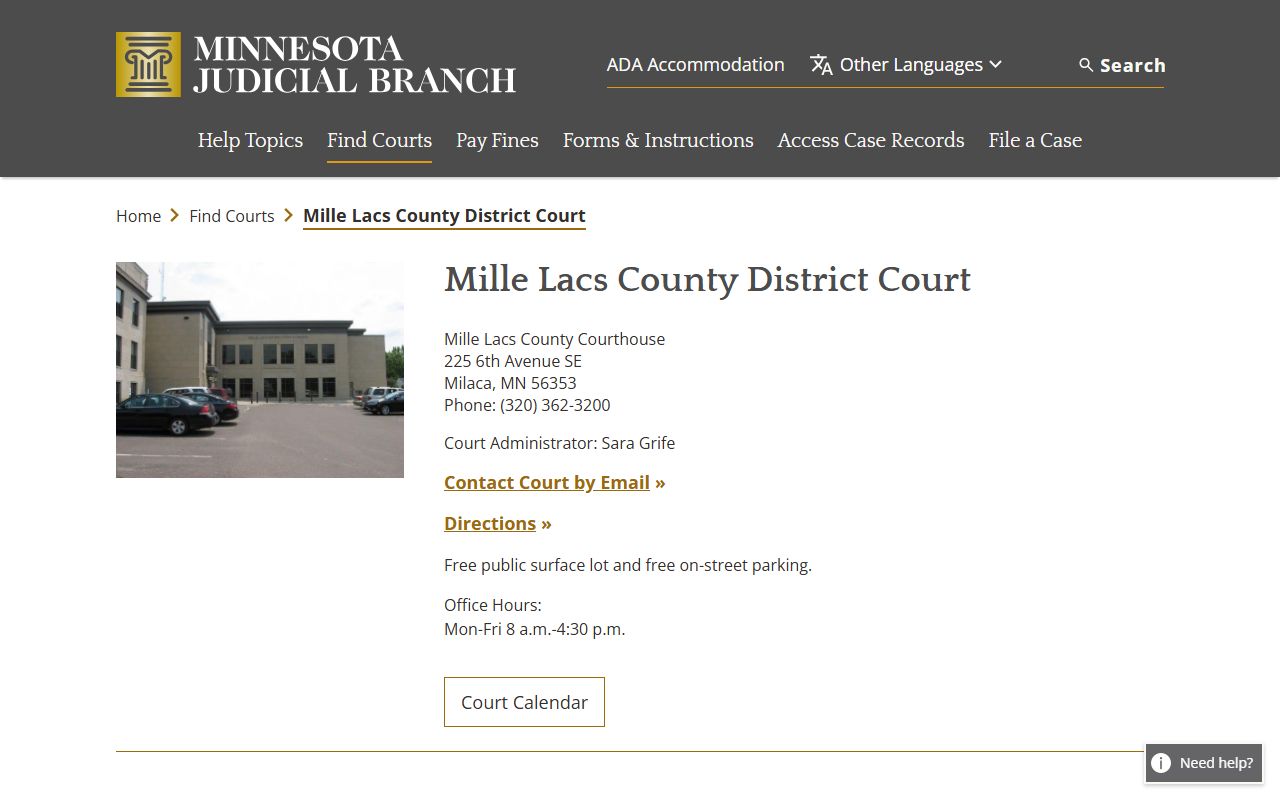
That court source is the right place to verify clerk hours, local court phone access, and whether a copy must be requested from court administration.
| MCRO Field | Type | Required | Search Notes |
|---|---|---|---|
| Search tab | Tab or button | Required choice | Name, Case Number, Citation Number, or Attorney. |
| Name type | Buttons | For name search | Person or Business. |
| First Name / Last Name | Text | For name search | Exact name or a trailing wildcard after two characters. Name searches can miss cases. |
| Date of Birth | Date or range | Optional | Search on an exact date or a date range. |
| Date Filed | Date or range | Optional | Use when the arrest or first appearance date is known. |
| Search by County | County selector | Optional but important | Choose Mille Lacs County to narrow the case search. |
| Attorney type | Buttons | For attorney search | Attorney name or Minnesota license number. |
MCRO says pending criminal, traffic, and petty misdemeanor cases with no conviction may not return by defendant-name search, even when a case exists. A case-number search can still return a pending case. That is why the jail roster, bail paperwork, citation, warrant notice, or court notice can matter. They may contain the case number needed to locate court records after an arrest.
Mille Lacs County Arrest Charging Records
A booking charge is not always the final court charge. Law enforcement may book a person on probable-cause allegations, a warrant, or a hold. The prosecutor then decides what to file. In Mille Lacs County, the County Attorney is the chief prosecutor and is aided by seven full-time assistant county attorneys. The office files criminal complaints and represents the State at hearings and trials.
Charging documents create the formal court record after a jail arrest. The exact document type depends on the case path and offense level. Minnesota research for this build supports complaint filing by the county prosecutor, and the broader criminal process also uses information and indictment labels in some cases. The table gives plain meanings without treating any one form as proof of guilt.
| Document | Who Uses It | What It Does | What It Does Not Prove |
|---|---|---|---|
| Complaint | Filed by the prosecutor based on law enforcement review. | Starts or supports the criminal case and lists alleged offenses. | It is an accusation, not a conviction. |
| Information | Used by a prosecutor in cases that proceed without a grand-jury indictment. | States the charge the State is pursuing in court. | It does not mean the defendant admitted guilt. |
| Indictment | Returned by a grand jury in cases where that process is used. | Authorizes prosecution on listed serious charges. | It is still not a verdict. |
After filing, the charge list can change. A charge can be amended, added, dismissed, reduced, or resolved by plea or trial. For that reason, the court record should be checked again after the first appearance and after later hearings.
Mille Lacs County Charge Status
Charge status tells where a case stands. It is one of the most important parts of court records after a jail arrest because the same person may have an arrest, a booking charge, a filed charge, and later a different final result. A roster detail may show charges, bail, court date, and court branch information. MCRO and court administration are the better sources for filed case status.
| Status | Plain Meaning | Record Caution |
|---|---|---|
| Pending | The charge is filed and the case is still open. | No conviction should be assumed. |
| Amended or reduced | The prosecutor changed the charge or offense level. | Compare the first filing with the current charge list. |
| Dismissed | The court record shows the charge is no longer being pursued. | Other charges in the same case may still remain. |
| Convicted | The case ended in a guilty plea, verdict, or other conviction entry. | Check the sentence and disposition date. |
| Warrant or hold | A court order or another agency may block release. | Ask the court or holding agency what must be cleared. |
Note: A court calendar absence does not prove a hearing was canceled, because not every matter is posted online.
Bond After Mille Lacs County Arrest
Mille Lacs County ties bail setting to first appearance. The jail information page states that an inmate is seen at 11 a.m. for first court appearance, Monday through Friday except county holidays, and bail is set at that appearance. Cash bail may be posted by bringing the exact amount to the jail's 24-hour door. The county page also says bail may be supplied through a bail bonds agent.
The county inmate information page is the source for first appearance and bail timing after a Mille Lacs County jail arrest.
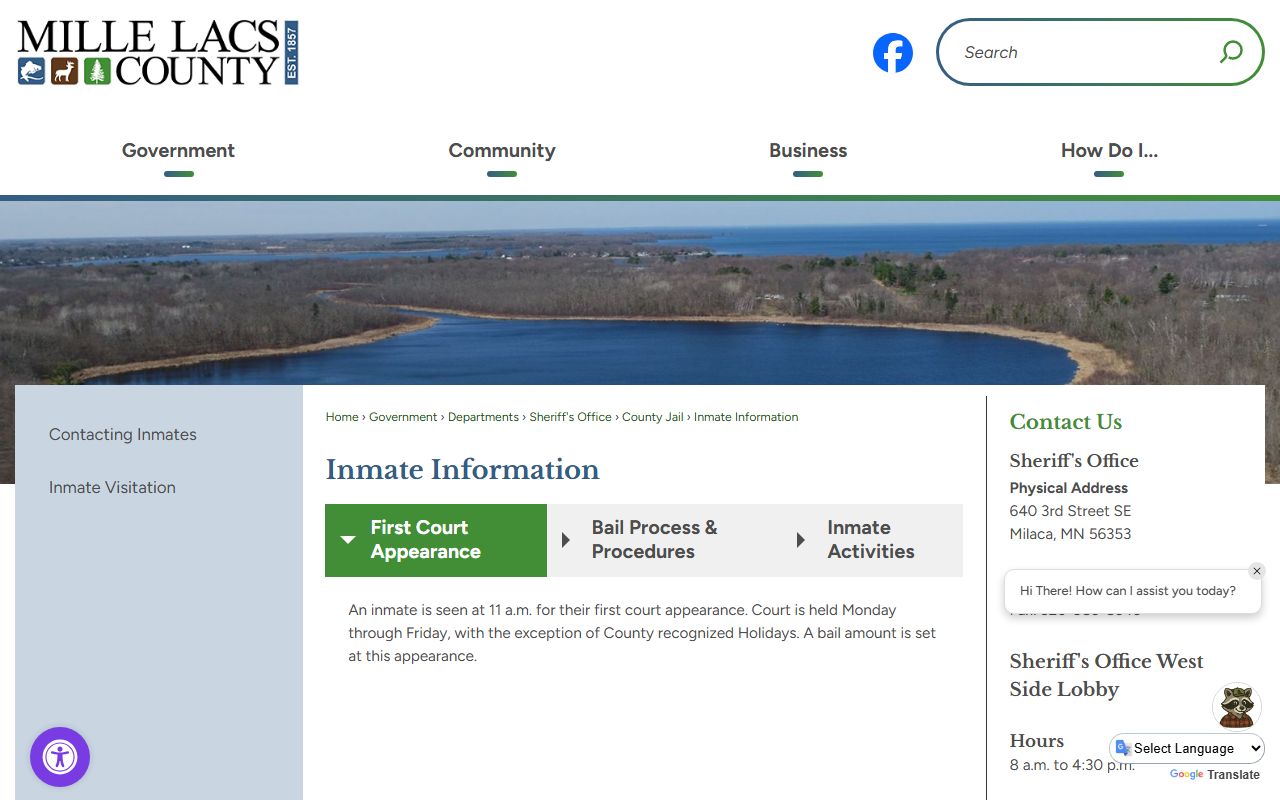
Bond information from the jail should be read with the court record, because a hold, warrant, or other agency detainer can affect release.
| Release Term | How It Works Locally | What to Confirm |
|---|---|---|
| Cash bail | Exact cash amount is brought to the jail's 24-hour door. | Confirm the current amount and whether any hold remains. |
| Bail bond | A bail agent supplies the bond under private fee terms. | Agent fees are not county fees. |
| Personal recognizance | The court may release a person on a promise to appear. | Review all release conditions. |
| No-bond hold | Release is blocked by the court or another agency. | Find out which authority must clear the hold. |
Mille Lacs County Warrants and Holds
A warrant can be the reason for a jail arrest or a later hold in the case. Mille Lacs County publishes an official Warrant List page. Research found that the county page is the stable access point, while the direct linked endpoint returned a 404 during the research pass. Because the live list fields were not visible, the safer record path is to start with the county page, then verify through the Sheriff's Office, District Court, MCRO, or a public data request.
Warrant types can include arrest warrants, bench warrants for failure to appear or noncompliance, search warrants used in investigations, and fugitive warrants or holds from other agencies. The jail roster may show a hold reason and agency. The court record may show the warrant event, hearing setting, bail condition, or order that led to custody.
The Sheriff's Office main phone is 320-983-8250. After hours and weekends, the office directs callers to 320-983-8245, with a toll-free number of 888-860-8250. The jail phone is 320-983-8244. Those channels are practical fallbacks when an online warrant or court record search does not explain why someone remains in custody.
Charges and Convictions Compared
Arrest, charge, and conviction are not the same thing. The county inmate locator itself warns that booking into jail does not establish guilt or conviction. Court records after a jail arrest may show one or more pending charges long before any plea, verdict, dismissal, or sentence. MCRO also warns that it should not be used for background checks.
| Record Point | Charge | Conviction |
|---|---|---|
| Stage | An allegation filed in court. | A final guilty result by plea, verdict, or qualifying court entry. |
| Proof level | Based on probable cause and prosecutor filing standards. | Requires proof beyond a reasonable doubt or a guilty plea. |
| Where seen | Jail roster charge rows and MCRO case records. | MCRO disposition entries and BCA public criminal history when public. |
| Reader risk | Can change or be dismissed. | Still may have limits, sealing, or expungement rules. |
The BCA Public Criminal History Search is the official Minnesota public criminal-history service required by Minn. Stat. 13.87. It is distinct from MCRO and from the jail roster. BCA criminal history focuses on public conviction history and related criminal-history data. MCRO is a court case lookup. The jail locator is a current-custody and booking tool.
Sealed and Expunged Court Records
Minnesota public access law starts with the Minnesota Government Data Practices Act. The research cites Minn. Stat. 13.03 for the presumption that government data are public unless classified otherwise, Minn. Stat. 13.82 for law-enforcement data, and Minn. Stat. ch. 609A for expungement. Those laws matter because court records after a jail arrest can be public at one stage and later limited by court order or statute.
| Record Limit | Sealed | Expunged |
|---|---|---|
| Public view | Hidden or restricted from ordinary public access. | Sealed under Minnesota expungement authority for eligible records. |
| Agency access | Some agencies may retain limited access when law allows. | Access depends on the order and Minnesota law. |
| Common trigger | Confidential case type, court rule, or court order. | Eligible dismissal, disposition, or statutory expungement process. |
| What to do | Ask court administration about access to the case. | Provide the order to agencies that maintain affected records. |
Juvenile records and juvenile photographs have separate limits under Minn. Stat. 260B.171. Active investigative material, victim or witness data, and records sealed by court rule may also be withheld or redacted. A missing online result does not always mean no arrest, no case, or no warrant exists.
Mille Lacs County Prosecutor Contacts
The Mille Lacs County Attorney's Office is at 225 6th Avenue SE, Milaca, MN 56353. County Attorney Corey Haller is listed as the current County Attorney. The office phone is 320-983-8305, fax is 320-983-8408, and the toll-free number is 888-350-8305. Hours are Monday through Friday, 8 a.m. to 4:30 p.m. The office also provides victim assistance through a full-time Victim Witness Coordinator.
The Mille Lacs County Attorney page documents the prosecution role and victim-assistance services tied to court records after a jail arrest.
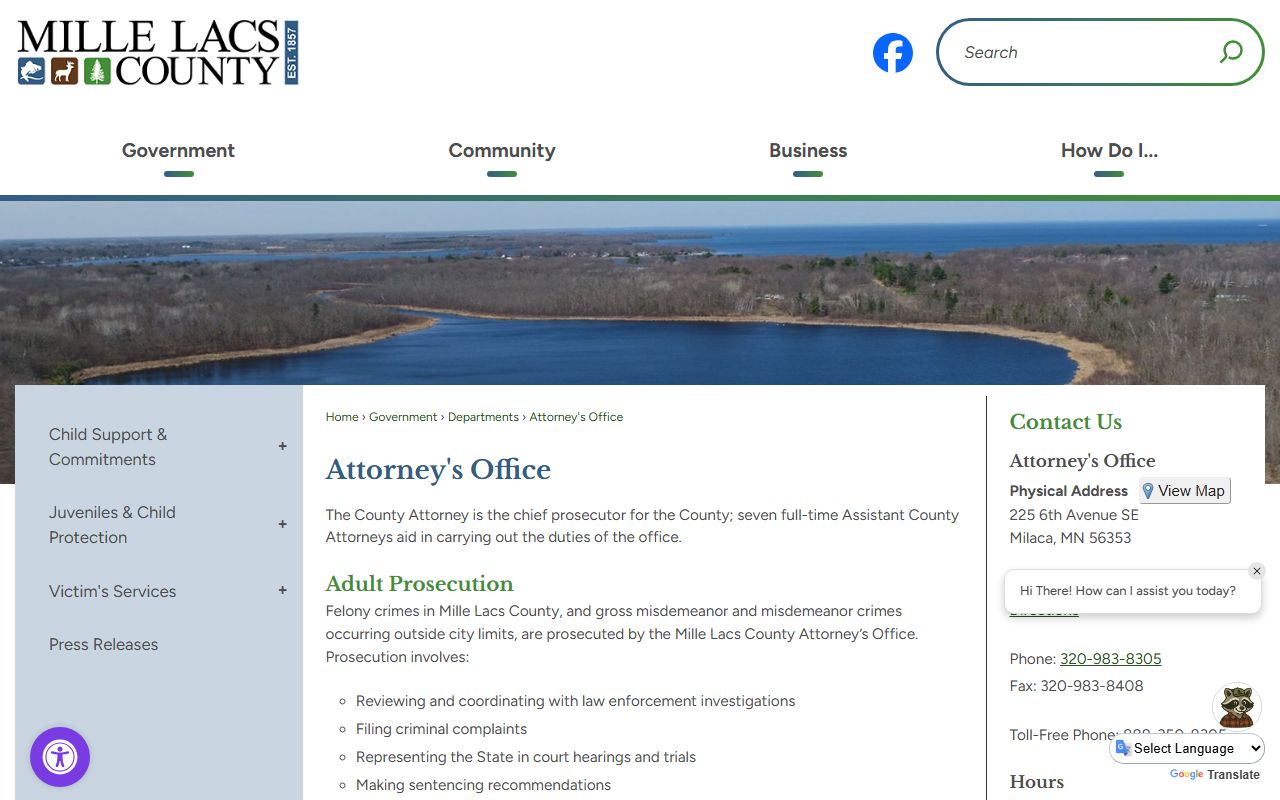
For public data outside MCRO, Mille Lacs County instructs requesters to ask the department that maintains the data and to use phone, mail, fax, or email request channels. The request should say it is under Chapter 13, describe the records clearly, and state whether inspection, copies, or both are requested.
Important: MCRO, jail records, and BCA history serve different purposes; do not treat a pending charge as a conviction.